
April Summit Recap: Economic Opportunity, Community Voice, and a Call to Action on the Westside
At this month’s Transform Westside Summit, neighbors, partners, and community leaders gathered once again to connect, reflect, and move forward together in the work of restoring Atlanta’s historic Westside.
The morning opened with a welcome from WFF President & CEO John Ahmann and Chief Development Officer Jon Ingram, followed by a powerful devotion from Grove Park resident and community leader Leah LaRue, and time for fellowship — a reminder that the strength of this work begins with relationships. The Summit then moved into a focused conversation on economic mobility and opportunity — with an emphasis on how the Westside is preparing to be ‘World Cup ready.’
A Community Strengthened by Its People
This month’s devotion was led by Leah LaRue, a Grove Park resident and Director of Communications and Neighborhood Relations for the City of Atlanta. Her message centered on the idea that strong communities are built not by uniformity, but by the diversity of people and perspectives within them.
Drawing from 1 Corinthians 12, LaRue reflected on the concept of the body — made up of many parts, each with a distinct role — and connected it directly to the work happening across the Westside.
Her message emphasized the importance of valuing each person’s contribution, even when those contributions look different. From those who ask hard questions to those who build bridges, she reminded the room that every role is necessary.
LaRue encouraged attendees to not only recognize those differences, but to actively support one another in the work — reinforcing that lasting progress requires both individual courage and collective effort.
World Cup Readiness and Economic Opportunity
Following the devotion and an update on Home on the Westside, the morning moved into the Summit’s featured presentation focused on economic mobility and the question of how opportunity is created — and who has access to it. The upcoming World Cup served as a central lens for the conversation — not simply as a global sporting event, but as a moment of opportunity for the Westside.
Leaders emphasized that preparation goes beyond hosting. It requires ensuring that residents, businesses, and communities are positioned to benefit from the economic activity and visibility that will follow.
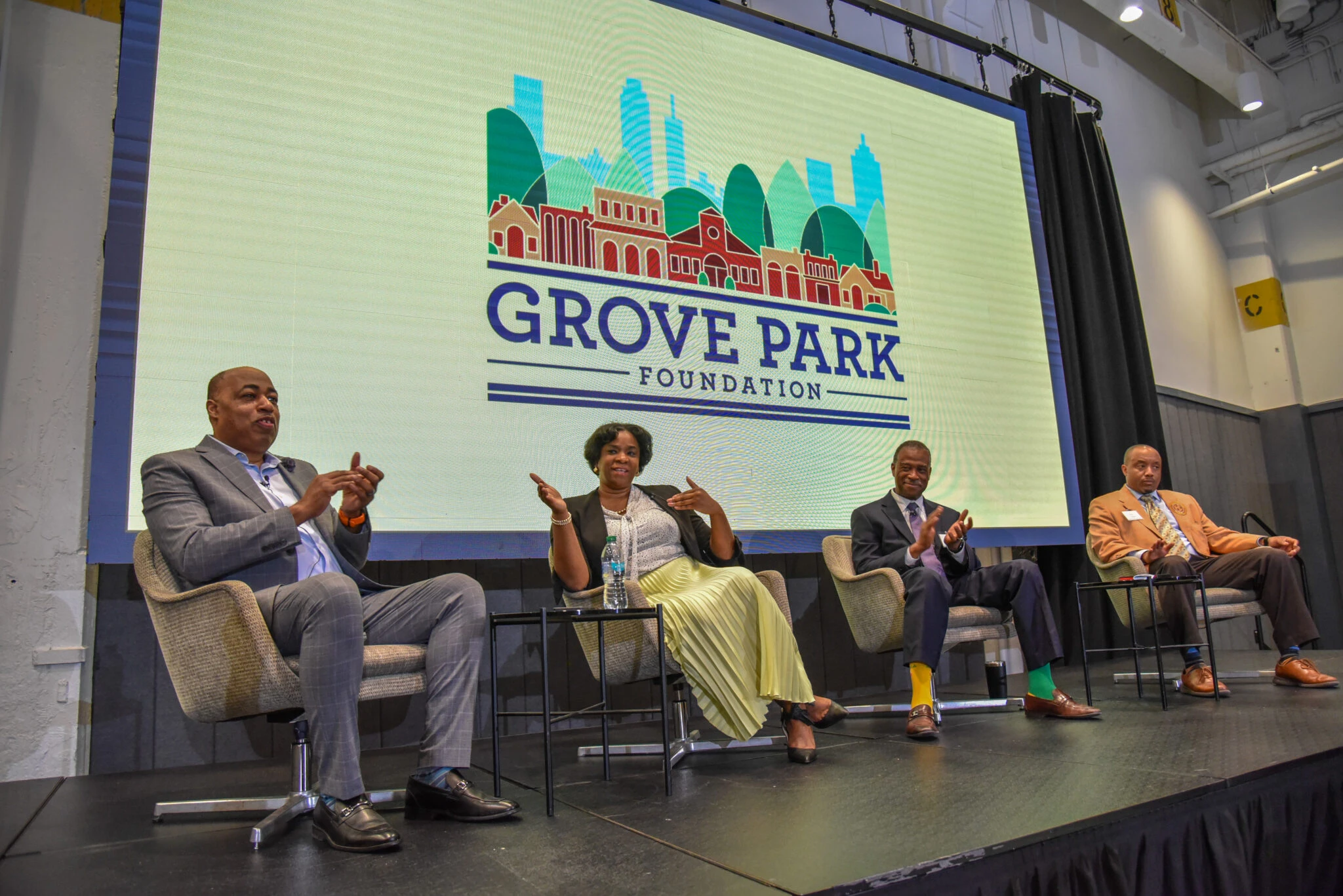
Led by Gavin McGuire, Executive Director of the Grove Park Foundation, the conversation began with a powerful reflection from McGuire, who grounded the discussion in a simple but striking moment from his daily commute.
“The first word that came into my head was economic mobility,” McGuire shared, describing a grandmother on her porch, a mother walking her child to school, and a man heading to work.
Each moment, he explained, represents a different experience of opportunity — and a different set of questions about access.
“When we say opportunity… opportunity for who?” he asked, challenging attendees to consider not just the presence of opportunity, but its accessibility.
McGuire emphasized that the goal is not simply to talk about progress, but to ensure that everyone has a pathway to participate in it.
“This is not just a panel discussion. This is a call to action.”
Preparing the Next Generation for Opportunity
Atlanta Public Schools Board Chair Jessica Johnson spoke to the role of education in shaping long-term economic outcomes.
“When I think about our students in APS and our role as board members and leaders in the district, it really is to empower our students to shape the future,” said Johnson.
Highlighting new initiatives being launched on the Westside — including community hubs and expanded career pathways — Johnson emphasized the importance of helping students clearly see their future..
“When students can see what’s next for them, they’re more motivated to show up and succeed,” said Johnson.
She also pointed to the intentional focus on launching innovative programs directly within Westside communities. By connecting education to real-world opportunities, Johnson shared that APS is working to ensure that students are not only prepared to graduate, but to lead.
Building Communities That Support Growth
From a development perspective, Eric Pinckney, President of Program Management at The Integral Group, emphasized the importance of creating environments where people choose to live, work, and invest.
“Place and environment matter,” said Pinckney.
He reflected on how communities evolve when the right systems are in place — from strong schools to infrastructure to sustained partnership. “But it’s all about the people that live there,” he added.
Pinckney underscored that successful development is not just about physical transformation, but about creating communities where people choose to stay and invest in their future.
Unlocking Opportunity Through Knowledge and Access
Eric Fears, Business Development & Strategy Consultant at Grove Park Foundation, brought the conversation back to the individual — focusing on the importance of building both understanding and confidence within the community.
“Economic development starts at the table,” said Eric Fears. He emphasized that understanding how systems work is essential to participating in them. “We have to improve our economic IQ and our economic confidence.”
Through initiatives like small business training and “World Cup Ready” programming, Fears highlighted the need to ensure that residents are equipped not just to witness change, but to participate in it.
He also reinforced that this work must be collaborative, not prescriptive. “I don’t make things for people — I collaborate,” he remarked.
Looking ahead, Fears described a broader vision for the Westside as a hub for innovation and opportunity.
“We want to turn this into an innovation corridor,” he said, pointing to a future shaped by both community voice and shared investment. Through surveys to gather that community voice, Fears assured, “We can put a comprehensive plan together so that over the next 10 years we see a different Westside and the Westside that you want, not the Westside that somebody else wants for you.”
A Call to Action for the Westside
Throughout the conversation, one message remained clear: the work of economic mobility cannot happen in isolation.
It requires collaboration — between residents, organizations, institutions, and partners — all working toward a shared vision of opportunity that is accessible, inclusive, and community-driven.
As the World Cup approaches, that call to action takes on even greater urgency — positioning the Westside not just as a place of investment, but as a community prepared to meet opportunity with intention.
Because the future of the Westside is not something that will be decided for the community — it will be shaped by it.
Missed the event? Watch the full April Transform Westside Summit on YouTube.